1/31/13
11/22/12
To Nome Following The Iditarod 2012. Click the links below and watch the videos.
Click here to watch Part 1.
Part 1: Four "Lower 48" Super Cubs Find There Way To Alaska
Click here to watch Part 2.
Part 2: Jacob And I Join The "Lower 48" pilots
Click here to watch Part 3.
Jacob and I stayed in Alaska. They had an great trip back.
9/5/12
6/20/12
We purchased another cub to use as a tailwheel trainer. It may not be pretty, but we will change that. If you get beyond the appearance then it is a very good Cub. N7461L is a 1975 PA-18-150 with 750 hours TTAF. It has never been in an accident. The engine was topped and it has a 160 HP conversion. We will get the cosmetics fixed. We installed 31" Bushwheel tires, heavy gear, and safety cables for off-airport/bush training coarse.
3/24/12
Jacob and I flew the Iditarod trail to Nome this year. We travelled and camped with five Super Cubs. This is Jody Niesen taking off from Melozy Hot Springs. We camped at Skwentna, Farewell Lake, Melozy Hot Springs, Ruby, and Serpentine Hot Springs. We stayed in a motel at Nome and watched Dallas Seavey cross the finish line.
Contact me if you are interested in flying the Iditarod trail in the future.
1/31/12
1/26/12
FSS phone numbers
Direct Phone Numbers for FSS
Many pilots call the Flight Service Station (FSS) to get weather. The published phone number for FSS is 1-800-WX BRIEF (800-992-7433). I do not use this number. This toll free number does not go directly to Kenai FSS but goes to a master switchboard. The master switchboard routes the call to a FSS that is in the geographic area where you made the call. This will create a problem if you use a satellite phone. The FSS switchboard thinks you are calling from the home office of the satellite phone company. The call will be routed to a FSS out east. The FSS person you get on the phone will know nothing about your needs in bush Alaska.
Instead of calling 1-800-992-7433, I call directly to the FSS that knows the most about the area I will be flying. I have a list of direct numbers for the Flight Service Stations in Alaska.
FSS Barrow 907-852-2511
FSS Cold Bay 907-532-2454, 800-478-7250
FSS Deadhorse 907-659-2401
FSS Dillingham 907-842-5275
FSS Fairbanks 907-474-0137, 866-248-6516
FSS Homer 907-235-8588
FSS Juneau 907-789-7380, 907-586-7382
FSS Kenai 907-283-7211, 866-864-1737
FSS Ketchikan 907-225-9481
FSS Kotzebue 907-442-3310
FSS Nome 907-443-2291
FSS Northway 907-778-2219
FSS Palmer 907-745-2495, 907-745-3248
FSS Sitka 907-966-2221
FSS Talkeetna 907-733-2277
12/9/11
Garmin GTN 650 and Federal 3600 Wheel Skis installed in N9418C
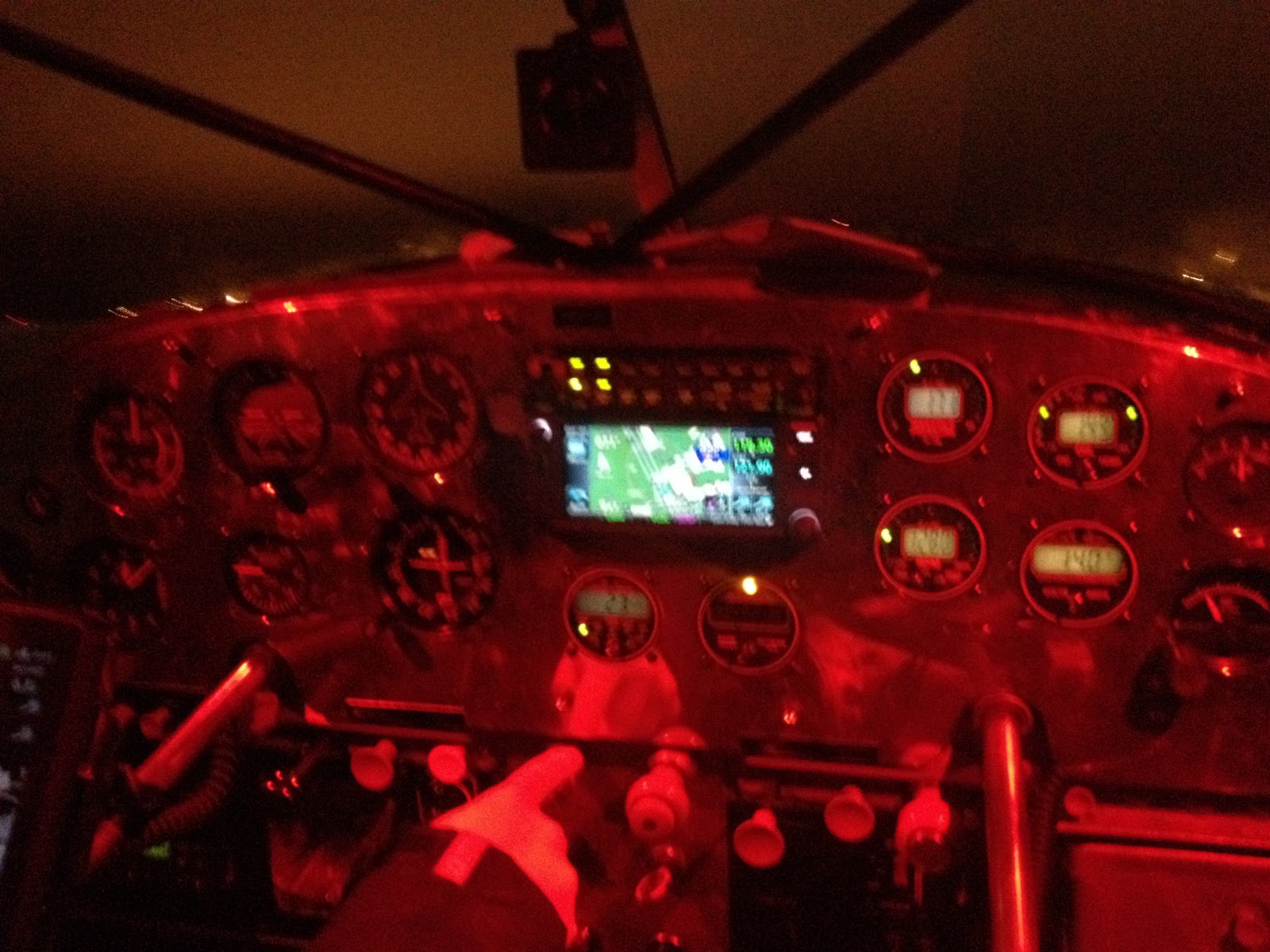
The Garmin IFR radio package is installed in N9418C, a 1955 Cessna 180. I am giving instrument flight training to Jacob Williams and Eugene DesJarais. The Garmin GTN 650 gives us the opportunity to file IFR on training flights and shoot approaches to all the small airports in the Susitna Valley. We do real time approaches with a glide-slope to Palmer (PAAQ), Big Lake (PAGQ, Wasilla (PAWS), Willow (PAUO), and Talkeetna (PATK). The WAAS capability of the GTN 650 provides a vertical navigation on RNAV approaches to all of these airports. We have the cross-fill option selected on the GTN 650. This sends the flight plan information over to Garmin's newest gadget, the Aera 795 that is mounted on the pilots control yoke.
Last night Jacob and I flew IFR from Soldotna (PASX) to Anchorage (PANC) in a snowstorm. We shot the ILS approach to runway 7 left at Ted Stevens International Airport. We cancelled IFR when we broke out of the clouds on final approach. We asked the tower if we could continue on the up-wind for 7 left and turn the up-wind into a left down-wind to land on the ice on the West waterway at the Lake Hood seaplane base. (PALH). The tower controller cleared us to proceed as requested. With this flight I introduced my son to hard IFR flying. I addition, we experienced the situational awareness that the our new Garmin package provides when flying in IMC conditions.
Subscribe to:
Posts (Atom)